


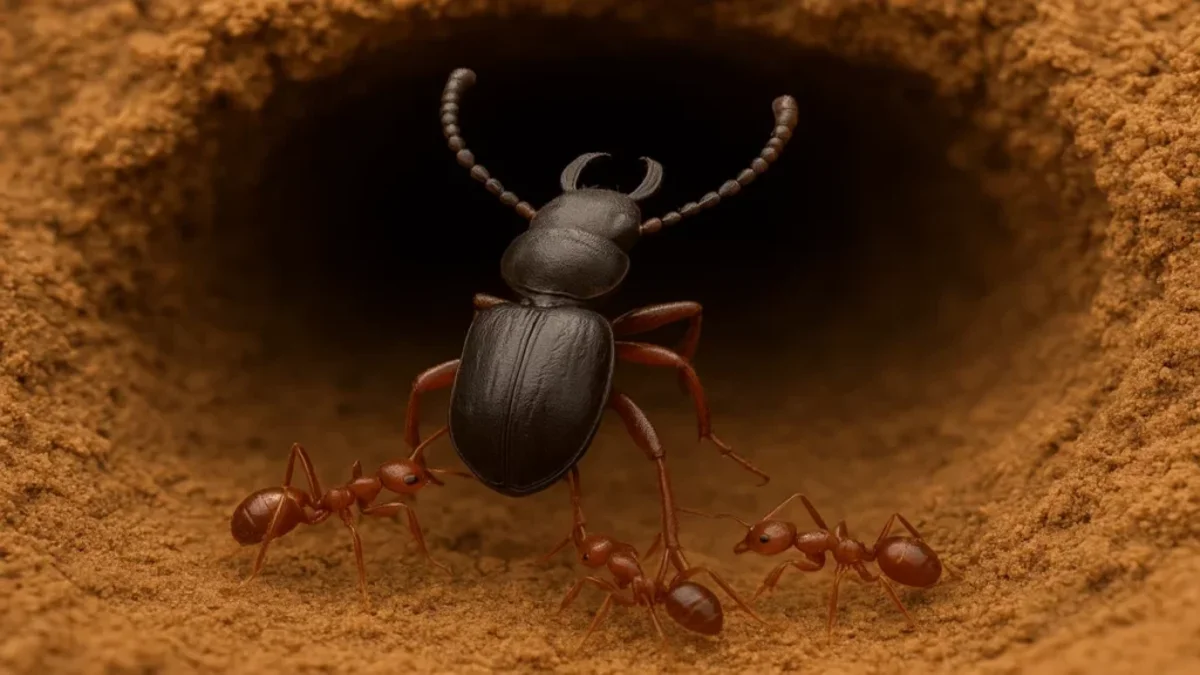
In the world of insects, where strict organization and discipline prevail, a biological miracle unfolds. Ants, the ultimate symbol of teamwork, appear to be an impenetrable fortress. Within a colony, every individual has a role, and every scent carries a specific meaning—a secret language known only to its members. Yet, amidst this rigor, a group of cunning beetles known as Paussinae (Flanged Bombardier Beetles) manages to infiltrate the heart of the colony, living as if they were one of its own.
These beetles do not use force; they rely on a unique biological intelligence that transforms them into true “chemical spies.”
The Language of Ants: Pheromones as a Passport Ants communicate through chemical signals called pheromones. These compounds serve as an identity card; any intruder lacking this chemical signature is immediately attacked. However, Paussinae beetles have cracked this code by developing the ability to mimic the ants’ chemical signature. They secrete hydrocarbons almost identical to those on the ants’ bodies, becoming “chemical ghosts.”
How the Deception Works
- Chemical Mimicry: The beetles produce compounds similar to the ant’s cuticle. Their scent blends perfectly into the colony’s atmosphere.
- Appeasement Behavior: Beyond scent, the beetles mimic ant movements. They offer liquid secretions from special glands as a “chemical bribe,” prompting the ants to adopt them rather than attack.
- Pseudo-Symbiosis: In some cases, ants go as far as feeding the beetles directly or carrying them between their mandibles, treating them like royalty or their own larvae.
The Benefits of Deception By manipulating the collective mind of the colony, the beetles gain:
- Protection: A secure environment away from predators.
- Free Meals: Access to the ants’ food stores.
- Safe Breeding: A protected space for their eggs to hatch.
The story of Paussinae beetles reminds us that the struggle for survival is not always about sharp fangs; sometimes, it is a silent battle of chemistry and cunning.