


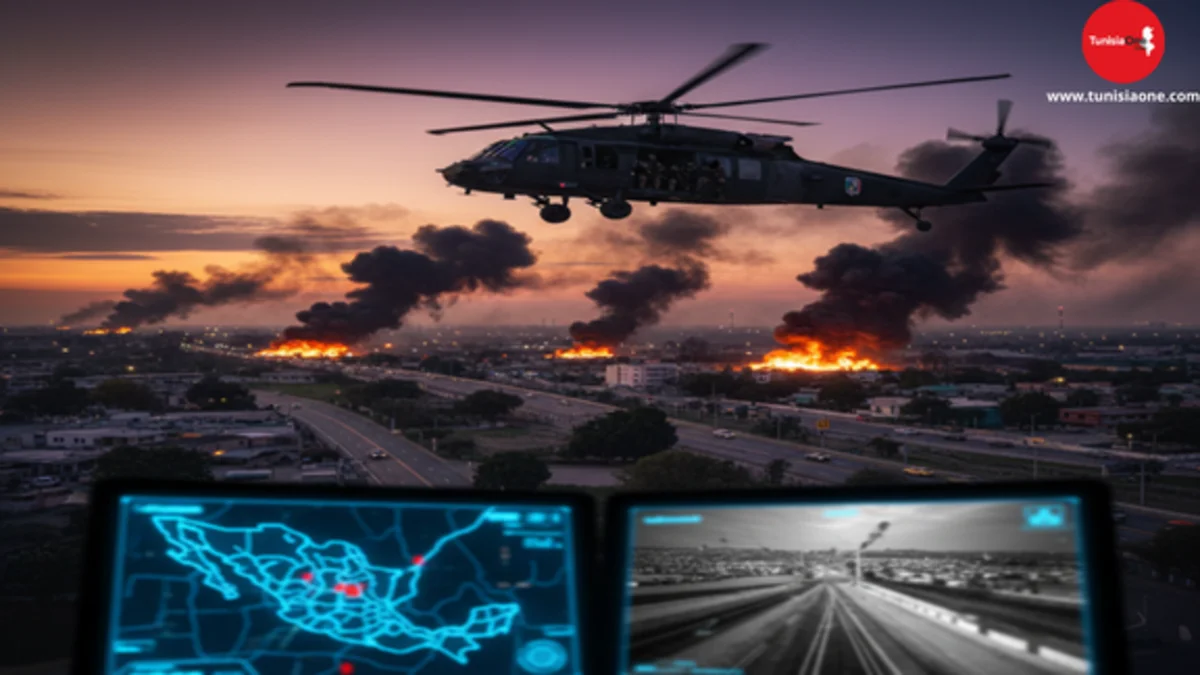
The End of the World’s Most Wanted Drug Lord On February 22, 2026, a high-stakes military operation changed the course of the global war on drugs. Nemesio Rubén Oseguera Cervantes, infamously known as “El Mencho,” was killed during a fierce confrontation with Mexican security forces. As the supreme leader of the Jalisco New Generation Cartel (CJNG), his death marks the most significant blow to organized crime in a decade. However, the victory came with a heavy price: a wave of retaliatory violence that has set the nation on fire.
The Takedown: A Masterclass in Military Intelligence
According to official reports from the Mexican Ministry of Defense, the operation was centered in Tapalpa, a stronghold in the state of Jalisco. This mission was made possible through unprecedented intelligence sharing between the Mexican government and the Trump administration. During the raid, elite troops were met with heavy resistance, including rocket launchers and weaponized drones. El Mencho was critically wounded during the battle and passed away while being airlifted to Mexico City. His death is a major milestone for President Claudia Sheinbaum’s administration and a fulfillment of security promises made to Washington.
مقالات ذات صلة / Related Posts
 Armageddon : Is Trump Pressing the “Chaos Button” in the Middle East and Iran in Spring 2026?
  Berlin Airport Paralyzed: “Black Ice” Halts All Flights Until Further Notice
  France’s Work Revolution: The New “AI and Remote Work” Law Sparks Debate
  The Korean Peninsula Enigma 2026: Is the Trump Administration Avoiding a Showdown with Kim Jong-un?
A Nation Under Siege: The Cartel’s Retaliation
The response from the CJNG was swift and devastating. In a coordinated display of power, cartel members established over 250 blockades across 20 Mexican states. They hijacked and torched buses, trucks, and gas stations to paralyze the country’s main arteries. Guadalajara, the heart of the region, was transformed into a ghost town as citizens sheltered in place and schools were closed. Smoke from the fires filled the skies over tourist hubs like Puerto Vallarta, leading to the massive cancellation of international flights and creating a sense of nationwide emergency.
The Trump Administration’s Victory
The fall of El Mencho is a significant political win for U.S. President Donald Trump. For the past year, the White House has placed immense pressure on Mexico to dismantle the cartels responsible for the fentanyl epidemic. White House Press Secretary Karoline Leavitt confirmed that the U.S. provided tactical support, labeling El Mencho as “Target Number One.” By successfully eliminating the man behind the largest fentanyl distribution network in North America, the operation validates Trump’s aggressive foreign policy regarding border security and drug trafficking.
Who Was El Mencho? The Architect of Modern Narco-Terror
Born in 1966, El Mencho rose from being a simple farmer to becoming a multi-billionaire criminal mastermind. After serving time in U.S. prisons in the 1990s, he returned to Mexico and founded the CJNG around 2007. His organization was known for its paramilitary discipline and early adoption of advanced technology, such as IEDs and drones. Under his leadership, the cartel expanded into all 50 U.S. states, dominating the markets for fentanyl, cocaine, and methamphetamines through extreme brutality and strategic expansion.
The Power Vacuum: What Lies Ahead in 2026?
Security experts warn that while the kingpin is dead, the war is far from over. The death of a leader often leads to the “balkanization” of a cartel, where smaller, more violent factions fight for control. There is a high risk of internal power struggles within the CJNG, as well as an opportunistic offensive from the rival Sinaloa Cartel. This could plunge Mexico into a deeper cycle of violence as various groups scramble to control lucrative smuggling routes worth billions of dollars.
Conclusion: A Precarious Victory The death of El Mencho is a symbol of justice, but the ensuing chaos highlights the fragility of national security in Mexico. Here at TunisiaOne, we will continue to monitor the situation as it evolves. The stability of Mexico remains a critical factor for global trade, energy prices, and international security in 2026.