


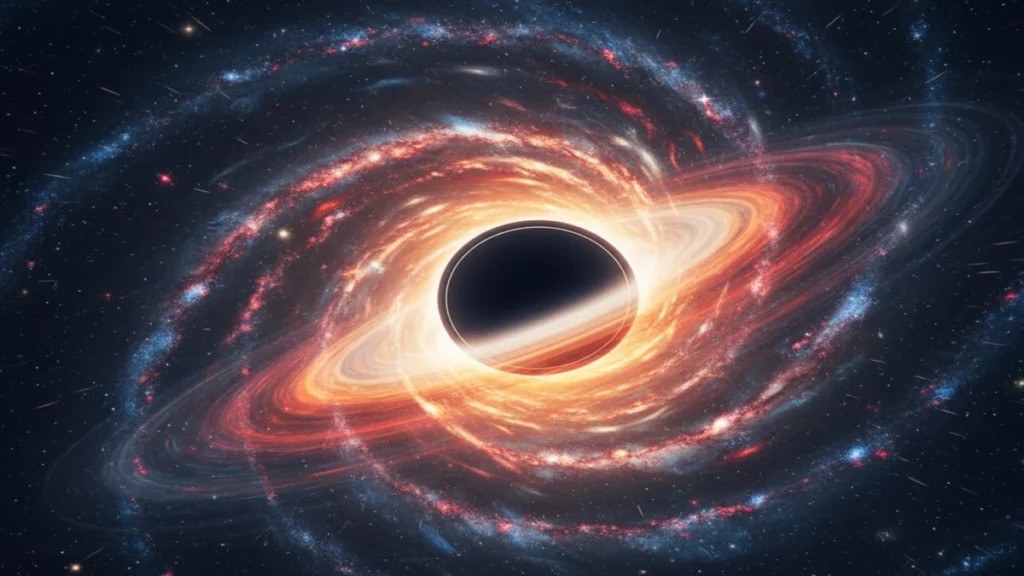
Often depicted as “cosmic monsters” devouring stars and matter, modern science has revealed that black holes are actually the structural backbone of the universe. Far from being mere gravity traps, these supermassive entities—lurking at the heart of nearly every galaxy—are the master regulators of galactic evolution and stability.
1. The Galactic Command Center (Massive Gravity) The essence of a black hole’s organizational role lies in its immense gravity, acting as an absolute center of mass:



- Structural Preservation: Without a central supermassive black hole, galaxies like our Milky Way would lose their distinct spiral structures. Acting as a “cosmic anchor,” it keeps billions of stars and gas clouds in a steady rotation for hundreds of millions of years.
- Solar System Analogy: Just as the Sun governs the orbits of planets, a black hole stabilizes the paths of stars across tens of thousands of light-years, preventing celestial chaos.
2. “Sagittarius A”: The Milky Way’s Metronome* In the heart of our galaxy lies Sagittarius A* (Sgr A*). With a mass four million times that of the Sun, its influence controls the movement of over 200 billion stars. The astonishing balance of our galaxy’s rotation is a direct result of Sgr A*’s gravitational pull, ensuring distant stars do not drift away.
3. Feedback and Galactic Evolution (Regulation through Destruction) A black hole’s scientific value also lies in a dynamic interaction known as “Feedback”:
- Regulating Galaxy Size: As a black hole feeds, it emits massive jets of radiation. This pushes gas away from the center, limiting the birth of new stars and ultimately determining the galaxy’s final mass and size.
- Cosmic Thermostat: Black holes act as regulators, preventing a galaxy from “burning through” all its raw materials too quickly.
Summary: Black holes are the cornerstones of cosmic order. This harmony between the universe’s strongest force and organized motion is a profound testament to the precision of cosmic architecture.