


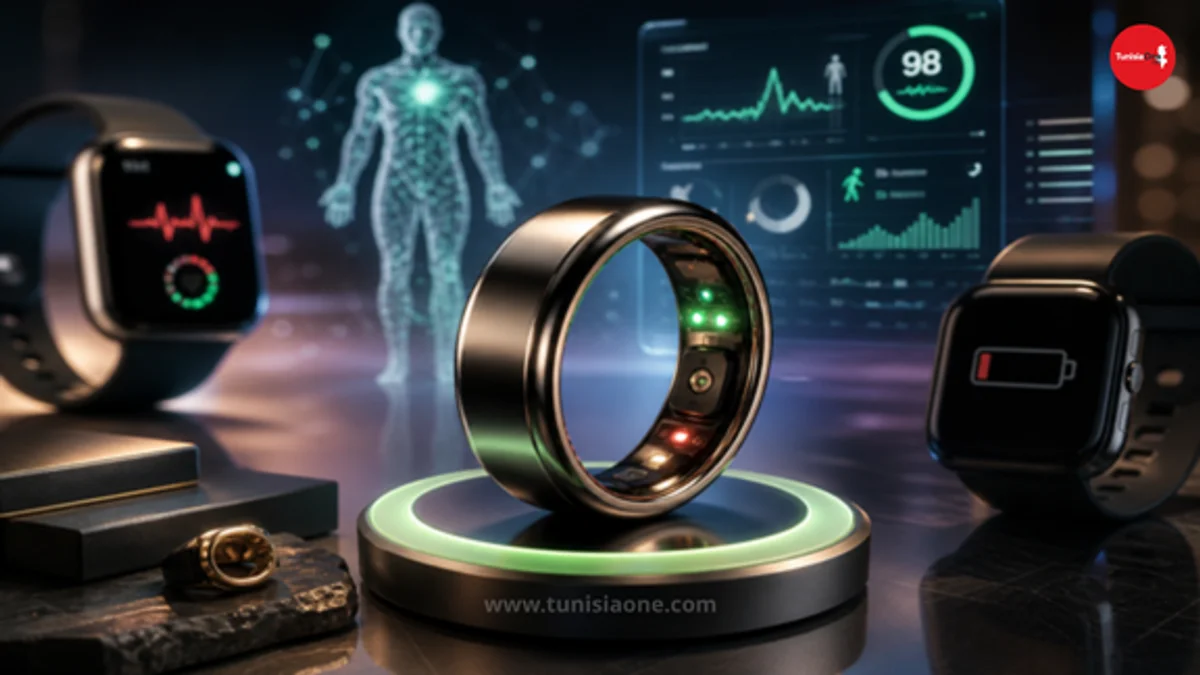
The landscape of wearable technology has undergone a seismic shift in 2026. For over a decade, the wrist was the undisputed throne for digital health monitoring. However, a silent revolution has taken place. The bulky, glowing screens of smartwatches are being replaced by the minimalist elegance of “Smart Rings.” This is not just a change in form factor; it is a fundamental shift toward “Ambient Intelligence”—technology that works for you without demanding your constant attention. As we move further into 2026, the question is no longer about novelty, but about dominance: Is it time to say goodbye to the traditional smartwatch?
🟢 The Science of the Finger: Why Rings Win on Precision
The primary reason for the mass migration to smart rings in 2026 is data integrity. Medical researchers have long known that the finger is a superior site for pulse oximetry and heart rate monitoring compared to the wrist. The finger has a higher density of capillaries close to the surface, and the ring fits more securely against the skin without the “light leakage” issues common in loose watch straps. In 2026, smart rings utilize advanced PPG (Photoplethysmography) sensors that provide 99.7% accuracy, matching hospital-grade EKG equipment. This precision allows for the early detection of arrhythmias and cardiovascular stress markers that watches often miss.
🟢 Battery Life: The Death of the Daily Charge
Perhaps the most significant “pain point” that smart rings have solved is battery anxiety. In 2026, while even the most advanced smartwatches struggle to exceed 72 hours of battery life due to their power-hungry OLED displays, smart rings have achieved a milestone of 10 to 15 days on a single charge. By removing the screen and focusing on low-energy Bluetooth protocols and localized AI processing, these rings offer a “set it and forget it” experience. This longevity is crucial for consistent health data; a device that is sitting on a charger for two hours every night cannot track your recovery or sleep cycles effectively.
🟢 Digital Detox and Aesthetic Sovereignty
2026 has seen a global movement toward “Digital Minimalism.” Users are increasingly fatigued by the constant haptic vibrations and notification pings on their wrists. The smart ring offers a “screenless” sanctuary. It collects sophisticated data in the background, only alerting the user via a subtle vibration in case of a genuine health emergency. Furthermore, the convergence of fashion and tech has reached its peak. Collaborations with luxury jewelry houses have turned these devices into high-end accessories made of Grade 5 Titanium, 18k Gold, and Aerospace-grade Ceramic, making the plastic-and-glass aesthetic of smartwatches look dated and industrial.
🟢 The Competitive Landscape: Samsung vs. Apple vs. Oura
The market is currently dominated by three philosophies:
Samsung has integrated the ring into a holistic “Galaxy Health” ecosystem, where the ring communicates with your smart appliances to adjust room temperature based on your body heat.
Apple has focused on “Gesture Control,” allowing users to navigate their Vision Pro headsets or unlock their Tesla with a simple finger flick
Oura, the pioneer, remains the gold standard for sleep coaching, using generative AI to provide a “Readiness Score” that feels eerily human in its accuracy
🟢 Conclusion: A New Era of Wearables
The smartwatch isn’t disappearing, but it is being demoted to a specialized tool for athletes and outdoor adventurers who need real-time GPS maps on their wrists. For the modern professional, the health-conscious individual, and the style-seeker of 2026, the smart ring is the definitive answer. It is more accurate, lasts longer, and looks better. The revolution is here, and it’s wrapped around your finger.
Is a smart ring more accurate than a smartwatch?
Yes, because the capillaries in the finger provide a much clearer signal for heart rate and oxygen sensors than the wrist area.
How long does the battery typically last?
In 2026, leading smart rings offer between 10 to 15 days of continuous use on a single charge.
Can I wear it while swimming or diving?
Most premium 2026 smart rings are rated for 10ATM (100 meters), making them perfectly safe for all water activities.