


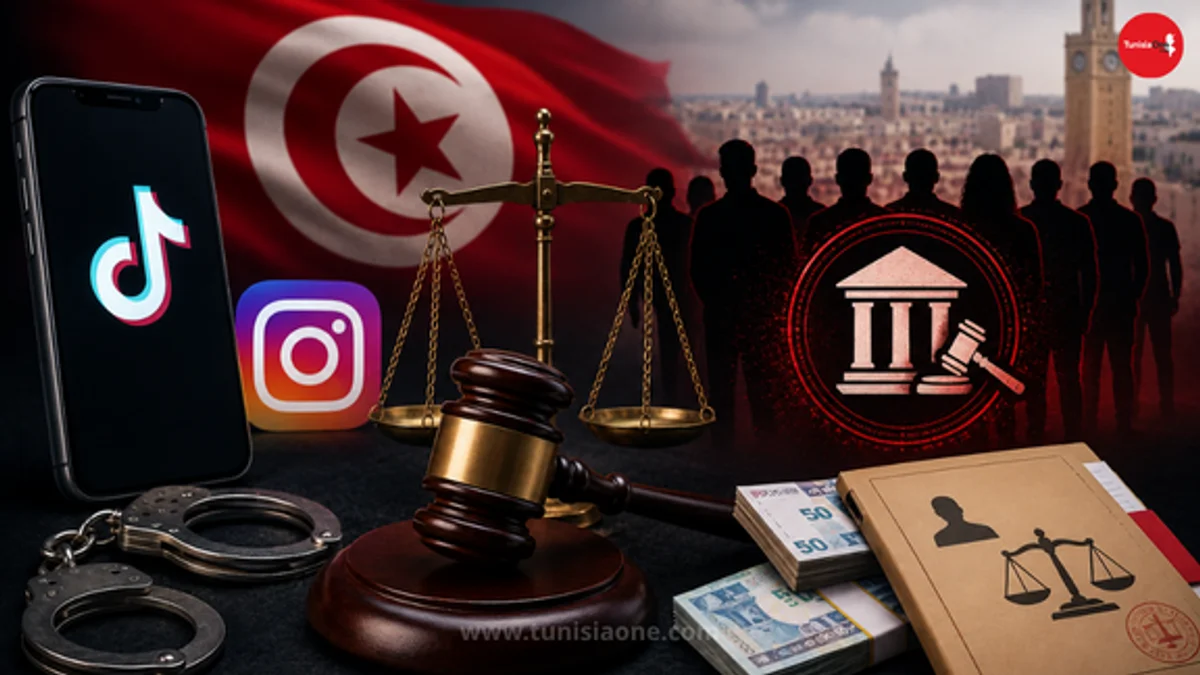
The Tunisian digital landscape is currently experiencing an unprecedented judicial tremor. Tunisian authorities have officially raised the red card against the moral and financial drift that has long plagued ultra-popular platforms such as “TikTok” and “Instagram.” The era of impunity is over! This case is no longer about provocative “live” streams or virtual feuds aimed at maximizing view counts. It has officially escalated into one of the most serious organized crime cases ever presented before Tunisian courts. The accusation chamber at the Tunis Court of Appeal has officially referred 18 prominent influencers and content creators to the Criminal Court, facing heavyweight charges that could cost them long years behind bars.
The Curtain Falls on the Suspect “Luxury” Behind the Scenes in Tunisia
For a long time, the Tunisian public watched with astonishment the display of immense wealth, luxury sports cars, and high-end real estate showcased by certain “content creators” on social media. This ostentation raised continuous questions, as the majority of them possessed no clear professions or declared commercial enterprises. Today, the decisive judicial crackdown arrives to provide clear answers, exposing the dark and hidden side of quick and easy money-making schemes within the virtual world.
How Did the Security Investigations Begin?
The investigations were triggered following detailed reports compiled by specialized security brigades fighting against cybercrime and financial delinquency. These inquiries were conducted in close coordination with the Central Bank of Tunisia through the Tunisian Financial Analysis Commission (CTAF). These reports highlighted massive, suspect financial flows and bank accounts that inflated exponentially in record time. Strong presumptions pointed toward the management of illegal networks exploiting the digital regulatory vacuum prior to the activation of deterrent legislations.
Who are the 18 Influencers Referred to Justice?
The list includes extremely famous figures. Among them are individuals who left Tunisian territory to broadcast from abroad, mistakenly believing they were safe from judicial prosecution. Other prominent names have been arrested and placed in pre-trial detention. Their digital activities focused primarily on “live challenges” based on public humiliation to collect virtual gifts (Coins), or on exploiting their large audiences to orchestrate suspect transactions and relationships behind closed doors.
Public Shock: Heavyweight Criminal Charges Under the Legal Microscope
The upcoming trial is not a minor misdemeanor related to public indecency or the use of vulgar language. These are major felonies threatening societal security and the national economy. In accordance with the provisions of the Tunisian Code of Criminal Procedure, this group faces three primary, highly dangerous indictments:
💰 Money Laundering via Virtual Gifts
This stands as the heaviest accusation in the case file. Investigations proved the existence of criminal networks transferring large sums of money from abroad, originating from illicit activities. These funds were subsequently injected into the influencers’ accounts through the support and gift features on TikTok and Instagram with the explicit goal of “cleansing” them and reintroducing them into the legal economic circuit. The Tunisian judiciary is treating this issue with absolute firmness to protect the financial stability of the state.
🔞 Systematic Sexual and Financial Exploitation of Minors
The investigations revealed intolerable violations that have deeply shocked the public. Certain content creators deliberately lured children and minors to participate in degrading videos and live broadcasts, severely violating human dignity. They exploited their innocence and ignorance of the law to generate rapid financial profits. This specific charge has provoked a massive wave of anger among Tunisian families, who are demanding the harshest penalties against anyone daring to threaten the psychological and moral integrity of children.
👥 Human Trafficking and Establishing Criminal Networks
This is no longer a matter of isolated, individual actions. The judicial files expose the existence of clandestine “pseudo-organizations” led by masterminds who manipulate these influencers. These networks actively work to recruit young women and young men by making dazzling financial promises. The victims subsequently find themselves trapped under the threat of photo leaks or financial blackmail, forced to execute degrading “live” scenarios that generate millions of dinars per month at the expense of their dignity.
Crucial Confrontation Next June: What Penalties Await the “Stars”?
The Tunisian public eagerly awaits the launch of the official hearings of this historic trial, scheduled for next June. The criminal chamber of the Tunis Court of Appeal will bear the responsibility of applying highly strict legal texts, which were recently promulgated or activated to regulate cyberspace.
The Legal Arsenal: Decree 54 and Anti-Money Laundering Law
The court will rely primarily on two fundamental legal pillars:
- Decree-Law No. 54 of the Year 2022: Relating to the fight against offenses connected with information and communication systems. This text provides for heavy prison sentences and massive financial fines for anyone who deliberately disseminates false news, damages the reputation of others, or assaults the physical and moral integrity of individuals via digital networks.
- The Organic Law on Combating Money Laundering and Human Trafficking: Strict legislation that provides for penalties that can reach life imprisonment and the confiscation of all real estate and financial assets of the involved individuals if their participation in organized crime is definitively proven.
Public and Expert Reactions to the Judicial Crackdown
Opinions within the Tunisian public and across media debate panels vary, yet they all converge on the absolute necessity of saving society from a moral decline.
Massive Support for Protecting Tunisian Family Values
The vast majority of citizens and civil society components expressed great relief regarding these judicial referrals. Many consider that “sanitizing the digital space” has become a matter of national security. This is particularly true given that TikTok in Tunisia had transformed, for some, into a platform promoting a culture of laziness and quick, effortless gains, presenting distorted role models as “references” for the younger generation at the expense of education, hard work, and perseverance.
A Human Rights Reading: Balancing Deterrence and Freedom of Expression
On the other hand, several legal experts and human rights defenders welcomed this initiative aimed at curbing organized crime. However, they emphasized the extreme importance of guaranteeing all rights to a fair trial for the accused. They recall that the application of the law must target financial corruption and criminal exploitation without turning into a mechanism for restricting legitimate digital freedoms or the genuine digital creativity practiced by thousands of conscious, law-abiding young Tunisiens.
Lessons Learned: How to Protect Yourself in the Digital Age
This case represents a decisive turning point in the history of internet regulation in Tunisia. It forces everyone to rethink their way of consuming digital content and to raise awareness among children regarding the dangers of virtual illusions.
Advice to Parents for Protecting Minors Online
- Activate Parental Control: On smartphones to closely monitor the applications accessed by minors.
- Establish Open Dialogue: Explain to children that the opulence displayed by certain influencers often hides a dark reality and heavy legal consequences.
- Report Immediately: Any attempt at blackmail or exploitation of minors online must be reported directly to the competent security authorities.
Follow us on TunisiaONE for comprehensive, exclusive, and real-time coverage of all developments, court hearings, and expected verdicts next June in this landmark case that changes the concept of “digital stardom” in Tunisia forever.
⚠️ Intellectual Property Warning and Copyright Notice: This in-depth investigative report has been entirely prepared and written by the editorial team of TunisiaONE . All rights reserved © 2026. It is strictly prohibited to copy, republish, or exploit partially or totally the content of this article without inserting a direct and active link (Do-Follow Backlink) redirecting to this page as a mandatory condition for citation. Any exploitation of the content without mentioning this source link will be considered a blatant theft of our work and will be subject to immediate legal prosecution as well as official complaints submitted to your digital platforms and search engines (DMCA Copyright Infringement) for the removal of the plagiarized content.
When will the trial of the 18 influencers begin in Tunisia?
The official hearings before the criminal chamber of the Tunis Court of Appeal will begin next June. A powerful legal and media presence is anticipated given the gravity of the file.
What are the main charges brought against these content creators?
The defendants face highly severe criminal charges: money laundering via digital platforms, sexual and financial exploitation of minors during live broadcasts, and establishing criminal networks for human trafficking.
Which laws will be applied during the judgment of these influencers?
The court will rely primarily on Decree-Law No. 54 of the Year 2022 relating to the fight against offenses connected with information and communication systems, alongside the Organic Law on Combating Money Laundering and Human Trafficking.
Do the judicial prosecutions also affect Tunisian influencers residing abroad?
Yes, the list includes prominent figures who broadcast their content from outside Tunisian territory. Judicial authorities are collaborating with international bodies to issue international arrest warrants to execute the court’s decisions.