


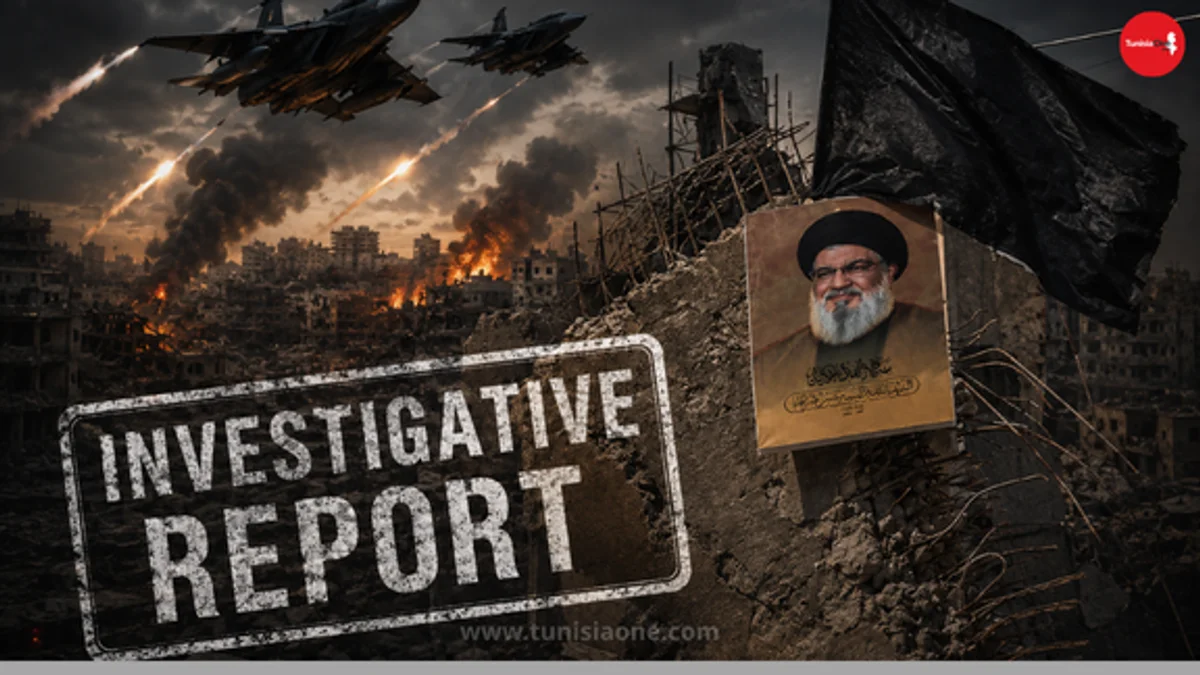
The Night that Redrew the Middle East
On the evening of 27 September 2024, the southern suburbs of Beirut were settling into what appeared to be an ordinary autumn night. In the skies above, however, squadrons of Israeli F-15I “Baz” fighter jets had already departed their bases, laden with a specialized, highly destructive arsenal. Their target was not a conventional weapons depot, but the absolute apex of the regional Axis of Resistance.


Within minutes, the Israeli military unleashed Operation New Order, a clinical and massive aerial strike that culminated in the assassination of Hassan Nasrallah, the long-standing Secretary-General of Hezbollah. This operation, one of the most complex intelligence and military maneuvers of the twenty-first century, continues to provoke critical questions regarding the profound security breaches and technological penetrations that exposed a subterranean fortress once deemed impenetrable.
The Subterranean Citadel: Engineering and Illusion in Haret Hreik
According to military blueprints and strategic assessments, Hezbollah’s supreme command headquarters lay buried eighteen meters beneath the earth. It was strategically situated directly underneath a dense residential matrix of six interconnected high-rise buildings in the heart of the Haret Hreik neighborhood in Dahieh. Built utilizing sophisticated Iranian engineering techniques, the bunker was heavily reinforced with multiple layers of steel-reinforced concrete designed to withstand conventional aerial bombardments and seismic shockwaves.
For Hezbollah’s leadership, anchoring the command center within this heavily populated civilian enclave served as a deliberate humanitarian and moral shield, calculated to deter large-scale Israeli airstrikes due to the inevitable international outcry over civilian casualties. Furthermore, to deceive Western satellite surveillance, Nasrallah routinely recorded his addresses from mirror-image underground studios connected to a network of clandestine tunnels stretching for hundreds of meters. To combat electronic espionage, the group had long eschewed smartphones, relying instead on hardwired landlines and a archaic network of physical couriers.
The Critical Moment: How the Bunker Busters Pierced the Concrete
At 6:20 PM local time, the illusion of invulnerability shattered. According to disclosures published by major international outlets, including The New York Times, the Israeli Air Force deployed dozens of GBU-31 joint direct attack munitions, commonly known as “Bunker Busters.” The tactical doctrine behind the strike relied on synchronized, sequential detonations—each bomb penetrating a layer of reinforced concrete a fraction of a second before the next exploded deeper, ultimately causing the vertical collapse of the six residential structures above.
Security analyses indicate that Tel Aviv confirmed the success of the operation almost instantaneously through varied technical means. Unofficial intelligence assessments suggest that the sudden termination of highly secure, hardwired biometric monitoring signals or encrypted command feeds inside the bunker—severed by the catastrophic overpressure of the blast—provided immediate confirmation to the war room. The sheer force of the concussion sealed the emergency escape hatches leading to the surrounding tunnel networks, leaving those inside with no possibility of survival.
The Cyber Domain: How the Mossad Penetrated the Network
Military analysts contend that the ultimate success of the assassination of Hassan Nasrallah was predicated upon an unprecedented intelligence penetration years in the making. Weeks prior to the final strike, the audacious and highly synchronized detonations of pagers and walkie-talkies across Lebanon had already demonstrated that Israeli cyber units, notably the elite Unit 8200, had thoroughly compromised Hezbollah’s logistical and supply chains.
This technological dominance allowed international intelligence agencies to map the voice prints and physical movements of senior commanders in real-time. By narrowing the parameters of surveillance around critical nodes, Israeli intelligence achieved a transparent view of the group’s operational command structure just hours before the strike.
The Human Factor: Whispers of the Double Agent
While official investigations remain cloaked in state secrecy, Western intelligence circles continue to debate the extent of human complicity required to validate the precise timing of the fateful meeting.
1. The Regional Informant Theory
Reports published by French daily Le Parisien and various international intelligence journals pointed toward a high-level human asset within the regional coordination apparatus. These leaks suggested that an informant (often referred to under vague operational pseudonyms) had provided granular details regarding Nasrallah’s itinerary and the exact timing of his arrival at the Haret Hreik bunker, allegedly in exchange for financial security and political asylum in Europe. While these accounts remain difficult to independently verify, they highlight the psychological warfare defining the conflict.
2. The Infiltrated War Room Scenario
Alternative security assessments suggest that ground assets visually confirmed the arrival of the supreme command convoy into the subterranean entry points hours before the jets took flight. These theories argue that shifting political allegiances and internal friction within the broader regional alliance created critical vulnerabilities, transforming routine movements into actionable intelligence that was swiftly capitalized on by opposing intelligence networks.
The Shockwaves in Téhran: Institutional Paranoia
The repercussions of this systemic security failure immediately reverberated in Tehran. According to reports from the Reuters news agency, Iranian authorities enacted extraordinary emergency protocols in the immediate aftermath of the strike, abruptly relocating Supreme Leader Ali Khamenei to a highly fortified, undisclosed location within the interior of the country.
Western think-tank assessments indicate that sweeping counter-intelligence audits were initiated within regional security institutions. Persistent leaks hint at a comprehensive overhaul of strategic tunnel blueprints and command installations in sensitive cities such as Qom and Karaj, driven by the acute fear that highly classified logistical documents had been compromised by undetected double agents within the higher echelons of the regime.
Military Ledger: Verified Realities vs. Strategic Ambiguity
The tangible outcomes of Operation New Order can be classified into two distinct dimensions:
Verified Historical Facts
- Leadership Attrition: Hezbollah officially confirmed the death of its leader, Hassan Nasrallah, alongside Ali Karaki, the commander of the Southern Front, and Brigadier General Abbas Nilforoushan, the deputy commander of operations for the Iranian Revolutionary Guard Corps (IRGC).
- The Strategic Shift: The immediate declaration by the Israeli government of a new operational phase designed to systematically dismantle the command-and-control infrastructure of the Lebanese movement.
Ongoing Strategic Estimations
- Ballistic Capabilities: While Tel Aviv claimed to have neutralized a significant portion of the group’s strategic missile capabilities, independent defense analysts observe that decentralized, alternative command structures have allowed the movement to maintain a degree of operational resilience on the ground.
Conclusion: The Unanswered Questions of 2026
Today, in 2026, the cratered landscape of Haret Hreik stands as a stark monument to a single night that fundamentally altered the geopolitical architecture of the Middle East. As diplomatic and military maneuvers continue to reshape the region, the foundational question remains unanswered within the quiet corridors of global intelligence: Did the internal purges successfully sever the roots of espionage, or do the shadows of this information war conceal chapters yet to unfold?
What was the military objective of Operation New Order?
Operation New Order was the official codename designated by the Israeli military for the massive, precision airstrike launched on 27 September 2024 against Hezbollah’s underground central headquarters in Beirut, explicitly aimed at neutralizing its supreme leadership.
Was the assassination of Hassan Nasrallah a result of cyber or human intelligence?
Evidence suggests it was a sophisticated synthesis of both. Prolonged cyber infiltration (including the compromise of logistical communication devices) mapped the group’s command structure, while precise human intelligence from regional assets confirmed the exact timing of Nasrallah’s presence in the bunker.
What specific munitions were utilized to destroy the underground bunker?
International defense reports indicate that Israeli F-15I fighter jets deployed dozens of GBU-31 Joint Direct Attack Munitions (JDAMs). These heavy “Bunker Busters” utilized sequential, delayed-fuse detonations to systematically penetrate multiple meters of reinforced concrete before exploding in the subterranean depths.