


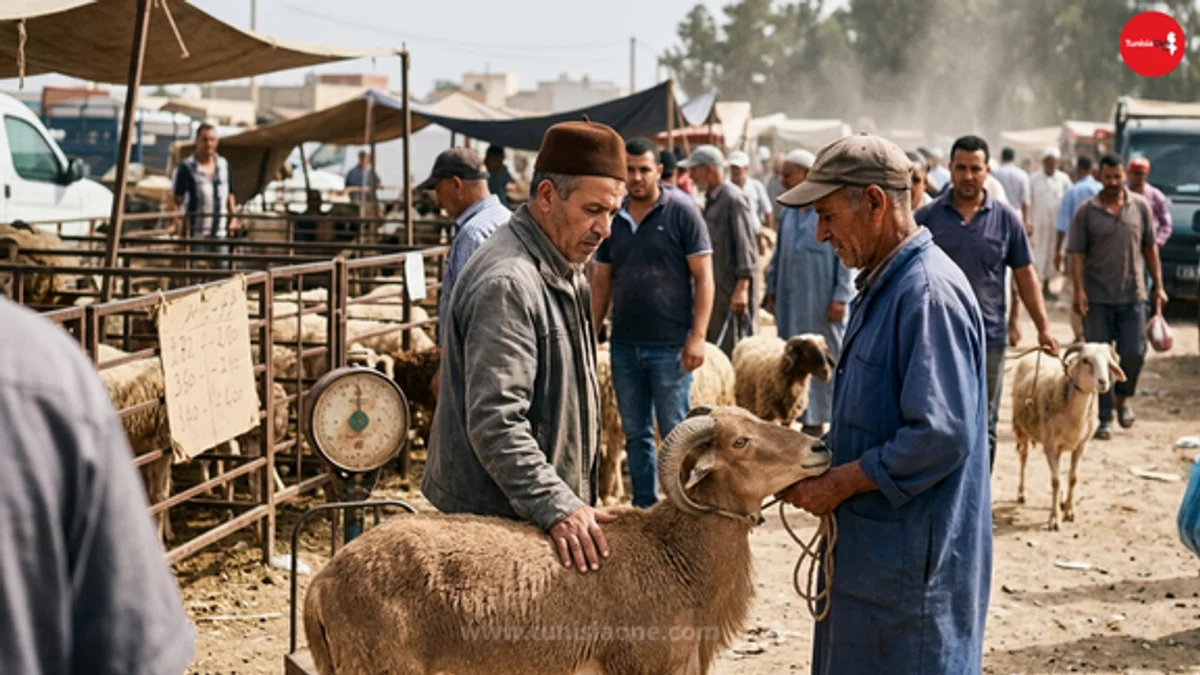
The Kickoff of a High-Stakes Consumer Marathon
Hardly had the Mufti of the Tunisian Republic, Sheikh Hichem ben Mahmoud, officially announced this past weekend that Monday, May 18, 2026, marks the first day of the holy month of Dhu al-Hijjah 1447 AH—thereby fixing the start of Eid al-Adha for Wednesday, May 27—than the country’s most intense socio-economic marathon ignited. This religious milestone immediately collided with a major economic directive: the official opening of state-regulated, weight-based livestock sale points across the country.
Suspended between spiritual devotion to this major Islamic holiday and financial dread over its sheer cost, the average Tunisian citizen finds themselves caught in a vice this year. On one hand lies a deep-rooted desire to uphold an ancient tradition and bring joy to their children; on the other, the brutal reality of a purchasing power severely eroded by structural inflation and a persistent cost-of-living crisis. Within hours, Eid al-Adha sheep prices Tunisia 2026 became the nation’s absolute fixation, shifting from digital discourse to a palpable, anxious reality across local markets.
مقالات ذات صلة / Related Posts

The Live-Weight Stock Market of 2026: Analyzing the State’s Official Rates
In an effort to regulate the market and curb the interference of speculative middlemen—locally notorious as “Ggacha”—the Ministry of Agriculture, Water Resources, and Fisheries, in coordination with the Interprofessional Group for Red Meat and Dairy Products (GIVLaits), published its official tariff grid for live-weight sacrificial animals. Operations kicked off early this Monday morning at pilot sales centers in Saïda (Manouba Governorate) and Radès (Ben Arous Governorate).
To provide transparent visibility for Tunisian consumers, the official pricing structure is synthesized in the table below:
(Official Eid 2026 Livestock Price Grid)
| Animal Weight Category | Official Price (Tunisian Dinar / Per kg Live Weight) | Approximate Animal Profile |
| Lightweight (Under 45 kg) | 27.000 DT | Suited for modest household budgets |
| Mediumweight (Between 45 and 65 kg) | 25.800 DT | The most sought-after segment in markets |
| Heavyweight (Over 65 kg) | 23.800 DT | Catered toward large extended families |
These figures reveal a grim mathematical reality for household finances: the smallest lamb, yielding barely 15 to 18 kilograms of net meat, will not trade for less than 950 to 1,200 Tunisian Dinars. This baseline figure comfortably outstrips Tunisia’s guaranteed minimum wage (SMIG), presenting working and middle-class citizens with a severe budgetary puzzle. Family finances are already heavily depleted from recent Ramadan expenditures and the looming financial pressures of the summer holidays.
Opening Day Frenzy: First-Wave Stocks Depleted in Record Time
The state-regulated sales hub in Saïda, located within the Oued Ellil delegation (Manouba Governorate), witnessed unprecedented crowds from the earliest hours of dawn. Despite the sharp, noticeable hike in prices, hundreds of citizens converged on the site to secure an animal, desperate to bypass the unpredictable price swings of the informal markets. According to on-the-ground reports broadcasted by major local stations such as Mosaïque FM and Tuniscope, the entire initial shipment of livestock was completely sold out in under an hour and a half after the gates opened.
This spectacular opening day rush does not reflect household financial prosperity. Instead, it is a defensive consumer reflex. Shoppers legitimately fear that prices in the traditional, open-air weekly markets (such as those in El Fahs or El Omrane Supérieur) will skyrocket to uncontrollable heights as May 27 approaches. Economic analysts note that this urgency proves Tunisian families prefer to sacrifice their final savings to secure a certified, health-inspected animal rather than risk being price-gouged by black-market speculators in the days ahead.
Roots of the Crisis: Why is the Tunisian Livestock Herd Collapsing?
To understand the scale of this crisis, an analysis of deep-set structural factors is vital. Agricultural unions affiliated with the Tunisian Union of Agriculture and Fisheries (UTAP) have been sounding the alarm for months: Tunisia is suffering a drastic, ongoing contraction of its livestock herd. The total number of sheep heads available for Eid al-Adha 2026 shows a sharp decline, driven by three major systemic catalysts:
1. Exponential Hikes in Animal Feed Costs
The Tunisian farming sector is heavily vulnerable to import dependencies regarding raw materials for feed manufacturing (such as soybeans, hay, and compound feed concentrates). Combined with the depreciation of the Tunisian Dinar and rising global commodity prices, the cost of raising a single sheep has doubled for farmers, forcing them to hike prices simply to survive economically.
2. Chronic Hydric Stress and Prolonged Drought
Climate change and successive years of severe rainfall deficits in Tunisia have devastated natural grazing pastures. The total absence of green forage has forced livestock farmers to rely exclusively on expensive, dry industrial feed. Burdened by these compounding losses, many smallholders have abandoned the sector entirely, selling off young ewes early to local butchers—a desperate move that has severely broken the herd’s natural reproduction cycle.
3. The Border Contraband Drain
Professional agricultural bodies routinely condemn the continuous smuggling of Tunisian sheep across national borders, as documented by the state-run Tunis Afrique Presse (TAP) news agency. Drawn by currency exchange differentials and swift black-market profits, smuggling networks are actively draining local supply right as domestic seasonal demand hits its absolute peak.
Social Media Backlash: Satire, Grim Humor, and Calls for Financial Realism
On the social front, Tunisian digital platforms—primarily Facebook and TikTok—have mutated into an open forum where citizens vent their shock at current market rates. Two distinct dynamics have emerged across the Tunisian web:
- Dark Satire and Memes: Internet forums are flooded with satirical images and viral videos ironically comparing the cost of a seasonal sheep to that of a used car. Viral posts mockingly suggest purchasing livestock via “24-month installment plans” or propose taking a simple smartphone selfie with a lamb as a cost-effective alternative to buying one.
- Pragmatic Boycott Campaigns: Spearheaded by domestic consumer protection groups, several grassroots movements are actively urging a “citizen’s boycott” of sacrificial purchases this year. Proponents argue that refusing to buy at these prohibitive rates (which hit 2,000 to 2,500 DT in some open markets) will break the speculative bubble, forcing middlemen to slash prices at the final hour while saving the domestic herd from total depletion.
Managing the Household Balance Sheet: A Rational Realignment of Priorities
Confronted by this financial bottleneck, Tunisian households are conducting a cold, rational audit of their domestic ledger. Sociologists and household economics experts concur that consumption habits tied to religious holidays must adapt to shifting realities. Societal expectations must not come at the cost of household financial stability, nor should they cannibalize vital long-term funds reserved for healthcare, utility bills, or children’s upcoming schooling costs.
Experts speaking on highly-rated radio networks like IFM and Radio Diwan emphasize that a new consumer maturity is taking root in Tunisia. This mindset actively prioritizes family budget preservation over the traditional social pressures of keeping up appearances. Since the true essence of the holiday is anchored in solidarity and community support, an increasing number of families are rationalizing costs—specifically by purchasing meat by the kilo from regulated local butcheries—rather than plunging themselves into months of crippling debt.
Conclusion: The Inevitable Collision of Tradition and Affordability in 2026
In conclusion, the 2026 Eid sheep pricing crisis in Tunisia is far more than a passing seasonal trend; it serves as a stark mirror reflecting the deep structural and macroeconomic headwinds buffeting the nation. The immediate depletion of livestock at state-regulated hubs proves that Tunisians remain deeply anchored to their cultural and religious heritage, even if it demands sacrificing their last financial reserves. However, this situation also stands as a solemn warning to policymakers: it is now imperative to rescue the domestic farming framework and protect local production before the traditional Eid sheep becomes, in the coming years, a luxury completely out of reach for the ordinary citizen.
What is the official date for Eid al-Adha 2026 in Tunisia?
A: According to the official statement from the Diwan of Ifta in Tunisia, Eid al-Adha for the year 2026 corresponds to Wednesday, Dhu al-Hijjah 10, 1447 AH, which falls on May 27, 2026, on the Gregorian calendar.
What are the official live-weight sheep prices for Eid this year?
The Ministry of Agriculture has capped official rates at 27.000 DT/kg live weight for animals weighing under 45 kg, 25.800 DT/kg live weight for the medium tier (45–65 kg), and 23.800 DT/kg live weight for livestock exceeding 65 kg.
Where are the state-regulated and monitored sales points located in Greater Tunis?
Official distribution operations have officially rolled out across two main state-monitored hubs: the first in the Saïda area (Oued Ellil delegation, Manouba Governorate) and the second in the Radès zone (Ben Arous Governorate).