


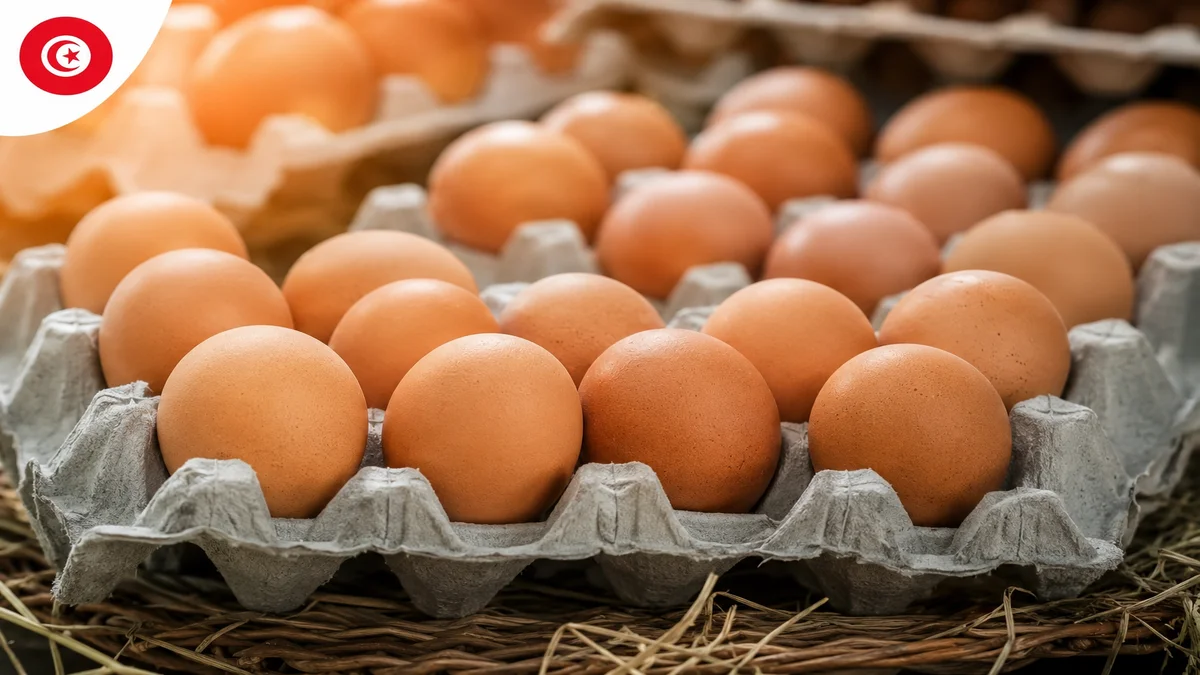
The Tunisian table egg sector is going through a difficult period, with producers facing rising production costs and growing economic pressure. Houssem Kadoura, General Coordinator of the Tunisian Confederation of Farmers and Cooperatives, has warned about the possible consequences of the current situation for the future of the sector.
According to Kadoura, continued financial losses could force some farmers to gradually abandon egg production. If this trend continues, the number of producers operating in the market could decline, potentially leading to greater concentration of the activity in the hands of a limited number of operators.
مقالات ذات صلة / Related Posts
 Crise des œufs de consommation en Tunisie : les producteurs alertent sur leurs pertes et réclament une meilleure régulation
  Club Africain : L’agenda de “fer” de Faouzi Benzarti après l’alerte du nul face à la JS Omrane أزمة البيض في تونس.. تحذيرات من خروج الفلاحين وتركيز النشاط في أيدي أقلية
  Incident de Bizerte : La violence scolaire est-elle devenue une crise de société en Tunisie ?
Egg production costs reach around 220 millimes
Speaking on Tuesday on the program “Menek Nesmaa”, Houssem Kadoura stressed the need to update the actual cost of producing table eggs in Tunisia.
He estimated the current production cost at approximately 220 millimes per egg, while noting that this figure does not fully take into account the additional impact of problems such as power outages and the heatwaves experienced in Tunisia during the summer.
These factors can place additional pressure on poultry farmers. Stable conditions are important for poultry farming, and disruptions caused by extreme heat or electricity problems can affect production conditions, increase expenses and put further pressure on farmers’ margins.
A significant gap between production and retail prices
Kadoura also highlighted the difference between the price received by producers and the price paid by consumers at the retail stage.
According to the figures he cited, four eggs are currently sold at the production level for around 840 millimes, while the retail price ranges between 1,200 and 1,400 millimes for four eggs.
He considers this difference significant and believes that the various stages of the distribution chain should be examined more closely.
Egg producers have to cover the costs associated with poultry farming and maintaining production, while the product goes through several stages before reaching consumers. These stages may include transportation, distribution and retail, all of which can contribute to the final price.
Farmers could leave the sector
One of the main concerns raised by the professional representative is the possibility that a number of farmers could abandon egg production if financial losses continue.
Such a development could have broader consequences for the market. A decline in the number of producers could gradually increase the concentration of production among a smaller number of operators.
Kadoura warned that this situation could eventually contribute to what he described as a rent-based economy within the sector, with production becoming increasingly concentrated in the hands of a minority.
Beyond its impact on farmers, such a development could also raise concerns about market balance, the availability of eggs and future price movements for Tunisian consumers.
Call for a fair quota system
As part of the proposed solutions, Houssem Kadoura called for the introduction of a fair and mandatory quota system for table egg producers.
Under this approach, each producer’s level of activity would be determined according to the actual needs of the market and the balance between supply and demand.
Better production planning could help reduce imbalances between the quantities produced and the market’s ability to absorb them. It could also give farmers greater visibility when planning their production.
Kadoura nevertheless stressed that any production program must be applied strictly and fairly if it is to achieve its intended objectives.
A sector facing several challenges
The current situation shows that the difficulties facing Tunisia’s egg sector are not limited to the price paid by consumers. They also involve production costs, climatic conditions, electricity supply and the organization of the distribution chain.
For professionals, the challenge is therefore to find a balance between several objectives: allowing farmers to continue operating under economically sustainable conditions, maintaining a stable supply of eggs and keeping prices within the reach of consumers.
Updating production costs and improving production planning are among the measures being put forward to help stabilize the sector.
In the longer term, the sustainability of Tunisia’s egg industry will depend on the ability of the different stakeholders to find a balance between producers’ costs, market requirements and consumers’ purchasing power.
The issue of table eggs therefore remains an important concern for Tunisia’s agricultural sector. Decisions regarding production planning, costs and distribution could play a key role in preventing the current difficulties from developing into a deeper crisis.
مقالات ذات صلة / Related Posts
Crise des œufs de consommation en Tunisie : les producteurs alertent sur leurs pertes et réclament une meilleure régulation Club Africain : L’agenda de “fer” de Faouzi Benzarti après l’alerte du nul face à la JS Omrane أزمة البيض في تونس.. تحذيرات من خروج الفلاحين وتركيز النشاط في أيدي أقلية Incident de Bizerte : La violence scolaire est-elle devenue une crise de société en Tunisie ?