


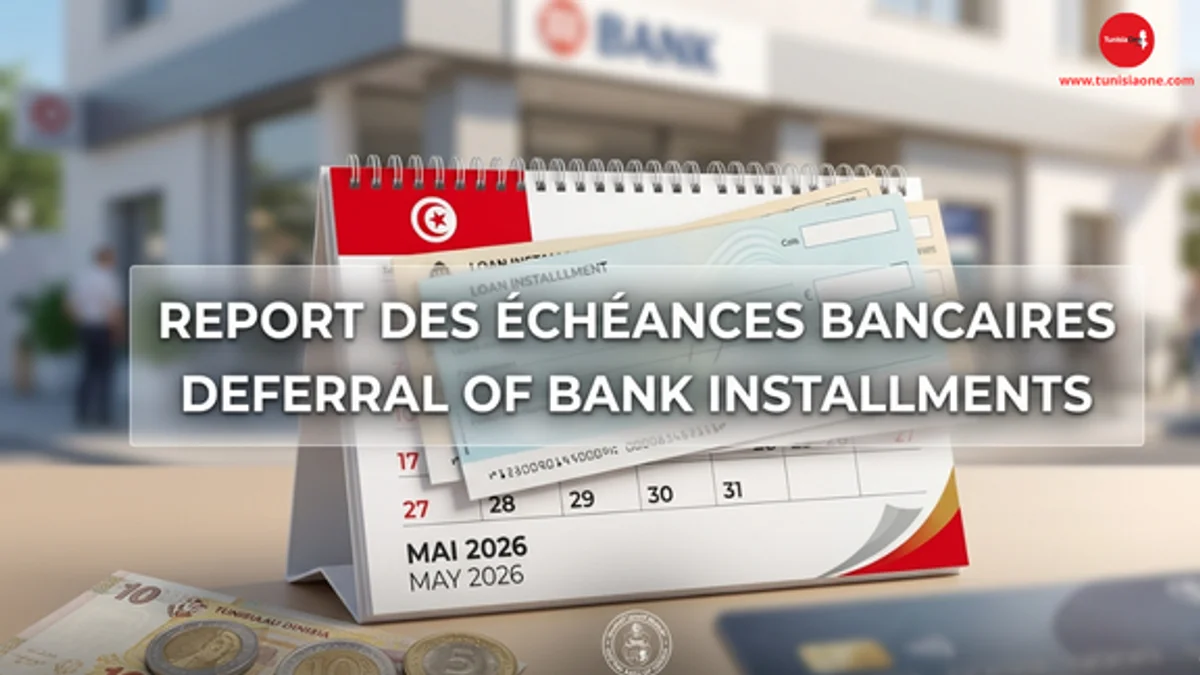
Amidst a challenging economic landscape, a new legislative proposal has emerged in Tunisia aimed at easing the financial pressure on households. On Wednesday, April 8, 2026, Member of Parliament Abdeljalil El Hani formally urged the Ministry of Finance and the Central Bank of Tunisia (BCT) to issue a circular regarding the postponement of loan installment payments for citizens.
Context and Economic Rationale The proposal suggests delaying payments until after May, providing immediate relief as Tunisians prepare for the significant expenses associated with Eid al-Adha. With inflation rates impacting the prices of essential goods, MP El Hani emphasized that such a measure is crucial to safeguarding the minimum purchasing power of the middle and lower-class families.
مقالات ذات صلة / Related Posts
 La Tunisie contre le monopole : Campagne nationale pour l’équilibre des marchés et la protection du pouvoir d’achat
  Tunisia Social Support: How to Receive a 350 TND Monthly Grant via the Elderly Family Placement Program
  Tunisia Salary Increase 2026: Official Roadmap Released by Ministry of Social Affairs
  Tunisia’s 2026 Interest-Free Loan Program: How to Apply for a 10,000 DT Small Business Grant via the Ministry of Employment
Expert Opinion: Positive yet Cautious Financial analyst Moez Hadidane commented on the initiative, describing it as “timely and positive.” However, he warned against repeating the communication gaps witnessed during the COVID-19 pandemic. Hadidane noted that any new directive must be crystal clear to prevent misunderstandings between commercial banks and their clients regarding interest rates and repayment schedules.
Implementation Strategies Hadidane outlined two potential paths for the banking sector:
- Maturity Extension: This involves shifting the entire loan schedule by one month. While thorough, it is computationally complex for banking systems.
- The “Advance Payment” Model: This is considered the more practical approach. The bank treats the deferred installment as a temporary advance to the customer, making it administratively easier to process.
Beyond Temporary Solutions While supporting the immediate relief, Hadidane stressed that deferring loans is a temporary fix for a much deeper structural problem. He called for comprehensive economic reforms to address the root causes of inflation in Tunisia, arguing that short-term liquidity injections should not replace a long-term strategy for price stability and wage growth.
Has the loan deferment in Tunisia been officially approved for 2026?
Currently, it is a formal proposal submitted by MP Abdeljalil El Hani. It awaits an official decision from the Central Bank of Tunisia and the Ministry of Finance.
Why was the loan postponement proposed at this time?
To alleviate financial pressure on Tunisian families facing high inflation and upcoming expenses for the Eid al-Adha holiday.
How will the loan deferment be implemented?
Experts suggest two ways: either extending the loan maturity or treating the deferred month as a temporary advance to the client.
مقالات ذات صلة / Related Posts
La Tunisie contre le monopole : Campagne nationale pour l’équilibre des marchés et la protection du pouvoir d’achat Tunisia Social Support: How to Receive a 350 TND Monthly Grant via the Elderly Family Placement Program Tunisia Salary Increase 2026: Official Roadmap Released by Ministry of Social Affairs Tunisia’s 2026 Interest-Free Loan Program: How to Apply for a 10,000 DT Small Business Grant via the Ministry of Employment