


Tunis – TunisiaONE | June 26, 2026
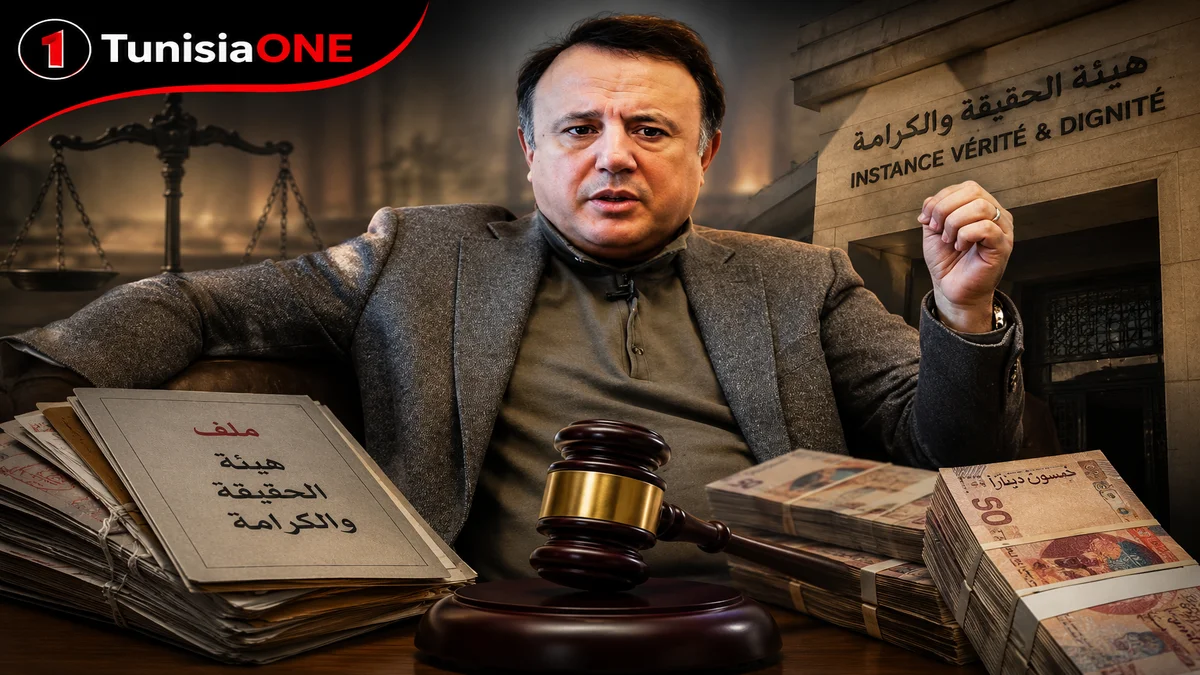
In a “judicial earthquake” that shook the halls of the Tunis Court of First Instance, the criminal chamber specializing in financial corruption cases issued a series of strict, “record-breaking,” and “historic” sentences late Thursday night. The rulings target businessman Mohamed Slim Chiboub and several others involved in the irregularities that marred the arbitration and reconciliation agreements with the “Truth and Dignity Commission” (IVD).
مقالات ذات صلة / Related Posts
 Tunis Court of Appeal Issues Final Verdicts Against Ennahdha Leaders Bhiri and Lounissi, and Journalist Zied El Heni
  25 ans de prison pour Sihem Bensedrine : La justice tunisienne rend des verdicts historiques dans les dossiers de l’IVD et de la BFT
  60 ans de réclusion pour la “Baronne” de la falsification immobilière en Tunisie
  Aéroport de Tunis-Carthage : 18 ans de prison pour une passeuse de drogue
The Conviction: A Marathon Night at the Court
Deliberations in this sensitive case continued until late into the night, amidst intense anticipation from legal and political circles. The court sentenced Slim Chiboub to 5 years in prison after investigations proved his involvement in crimes related to “a public official’s complicity in exploiting their position to obtain undue benefits, harming the administration, and violating legal regulations.”
Astronomical Figures: 1.7 Billion Dinars in Fines
The court did not stop at the prison sentence; it also addressed the financial aspect of the file, issuing restitution orders considered the largest in the history of corruption cases in Tunisia:
- Financial Penalty: Chiboub and the remaining defendants were ordered to pay a fine of 1 billion, 776 million, and 170 thousand dinars.
- Restitution: The court upheld the principle of “joint liability” to return an equivalent amount (1,776,170,000 TND) to the Tunisian State Treasury.
Read more
- Tunis Court of Appeal Issues Final Verdicts Against Ennahdha Leaders Bhiri and Lounissi, and Journalist Zied El Heni
- 25 Years in Prison for Sihem Bensedrine: The Court Issues Heavy Verdicts in the “Truth and Dignity Commission” and “BFT” Cases
- Rumor of Youssef Chahed’s Arrest in Canada: The Truth Behind the Headlines
- Kais Saied: 4 Strategic Measures to Address Irregular Migration in Tunisia
- Banking Strike in Tunisia 2026: Three Days of Shutdown… Affected Sectors and Customer Advice
- The Definitive 2026 Guide to Tunisian University Scholarships: Navigating the Digital Shift
- Scholarships in Japan: MEXT 2027 Applications Now Open for Tunisian Students
- Tunisian Passport Guide 2026: Step-by-Step Application & Biometric Transition
- Italy-Tunisia Labor Agreement 2026: New 5-Year Pathway for Legal Migration and Job Opportunities
Background: Between Transitional Justice and Corruption Suspicions
This ruling is not merely a “penalty” but a pivotal point in the judicial proceedings concerning the work of the “Truth and Dignity Commission.” Investigations revealed fundamental breaches in the reconciliation agreements, which were originally intended to provide reparations but were—according to the court—exploited to drain public funds. Observers believe this decision sends a firm message from the Tunisian judiciary regarding the pursuit of financial irregularities, even those masked by former institutional covers.
The Road Ahead: The Battle of the “Appeal”
As this is a primary court ruling, the decision remains subject to the standard litigation process. The defense team is expected to file an appeal within the legal time limits, meaning this case remains open to new legal possibilities, especially since the “Truth and Dignity Commission” files are among the most complex in Tunisia’s judicial history.
Why does this ruling raise questions about the “Appeal”?
Following the verdict, many followers are questioning the legal outcome regarding these massive financial figures. Legally, the Tunisian legislator grants defense teams the right to challenge these rulings before the Court of Appeal, a stage that allows for the reconsideration of:
- Assessment of financial damage: Is the financial figure (1.7 billion dinars) a final estimate or subject to revision based on defense evidence?
- Principle of joint liability: How will financial responsibility be distributed among the defendants in the event of varying degrees of involvement?
TunisiaONE continues to follow the details of this case and will provide the latest legal updates and statements from defense teams as they become available.
مقالات ذات صلة / Related Posts
Tunis Court of Appeal Issues Final Verdicts Against Ennahdha Leaders Bhiri and Lounissi, and Journalist Zied El Heni 25 ans de prison pour Sihem Bensedrine : La justice tunisienne rend des verdicts historiques dans les dossiers de l’IVD et de la BFT 60 ans de réclusion pour la “Baronne” de la falsification immobilière en Tunisie Aéroport de Tunis-Carthage : 18 ans de prison pour une passeuse de drogue