


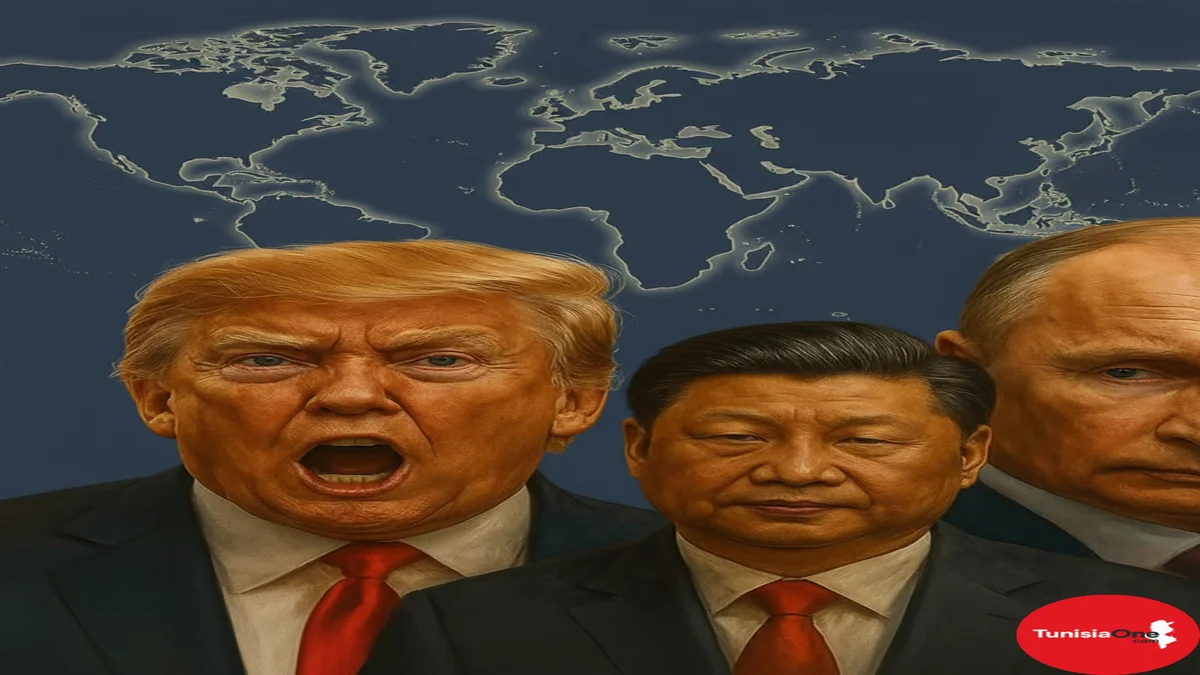
During his keynote speech in Sharm El-Sheikh on October 13, 2025, U.S. President Donald Trump delivered a strategic warning that resonated globally: “World War III will not start in the Middle East.” While appearing to bolster his image as a regional peacemaker, the statement serves as a pivot toward other volatile regions where real danger is brewing.
1. The Pacific Front: Taiwan as a Global Red Line By excluding the Middle East, Trump shifted the focus to the intensifying U.S.-China rivalry—a multi-front conflict.
مقالات ذات صلة / Related Posts
 هرمجدون: هل يضغط ترامب على “زر الفوضى” في الشرق الأوسط وإيران ربيع 2026؟
  Urgence en Méditerranée : La « Flottille de la Résistance » à 100 milles de Gaza sous haute surveillance
  Le Moyen-Orient sur un volcan : Le déploiement militaire américain annonce-t-il une guerre totale ? Armageddon : Is Trump Pressing the “Chaos Button” in the Middle East and Iran in Spring 2026?
- Supply Chain Warfare: The October 2025 decision to impose 100% tariffs on Chinese vessels highlights the economic battlefield. With Beijing controlling 80% of rare earth metal supplies, IMF estimates suggest this trade war could shrink global GDP by 10%.
- Military Flashpoints: Taiwan remains the “fuse.” Reports from the Carnegie Endowment (May 2025) warn that any clash in the South China Sea would likely pull Japan and Australia into a large-scale regional war.
2. The European Front: Russia Probing NATO Borders Europe remains the most traditional and immediate “hot” zone.
- Airstrikes and Incursions: In September 2025, 19 Russian drones breached Polish airspace, forcing NATO to intercept. Polish PM Donald Tusk stated, “We are closer to an open conflict than at any time since 1945.”
- Intelligence Warnings: German Intelligence Chief Martin Jäger warned parliament that Russia is expanding operations at an “unprecedented” rate, leading to the recent emergency closures of airports in Copenhagen, Munich, and Oslo.
Strategic Insight: Trump’s statement reflects a reality confirmed by data: global military spending has hit a record $2.443 trillion (SIPRI, 2024). Beyond conventional arms, the “Hybrid War”—including cyberattacks projected to cost $12 trillion globally—poses a more destructive threat than traditional warfare. Peace today is not just a slogan; it is the result of a delicate balance between strategic power and diplomatic wisdom.
مقالات ذات صلة / Related Posts
هرمجدون: هل يضغط ترامب على “زر الفوضى” في الشرق الأوسط وإيران ربيع 2026؟ Urgence en Méditerranée : La « Flottille de la Résistance » à 100 milles de Gaza sous haute surveillance Le Moyen-Orient sur un volcan : Le déploiement militaire américain annonce-t-il une guerre totale ? Armageddon : Is Trump Pressing the “Chaos Button” in the Middle East and Iran in Spring 2026?