


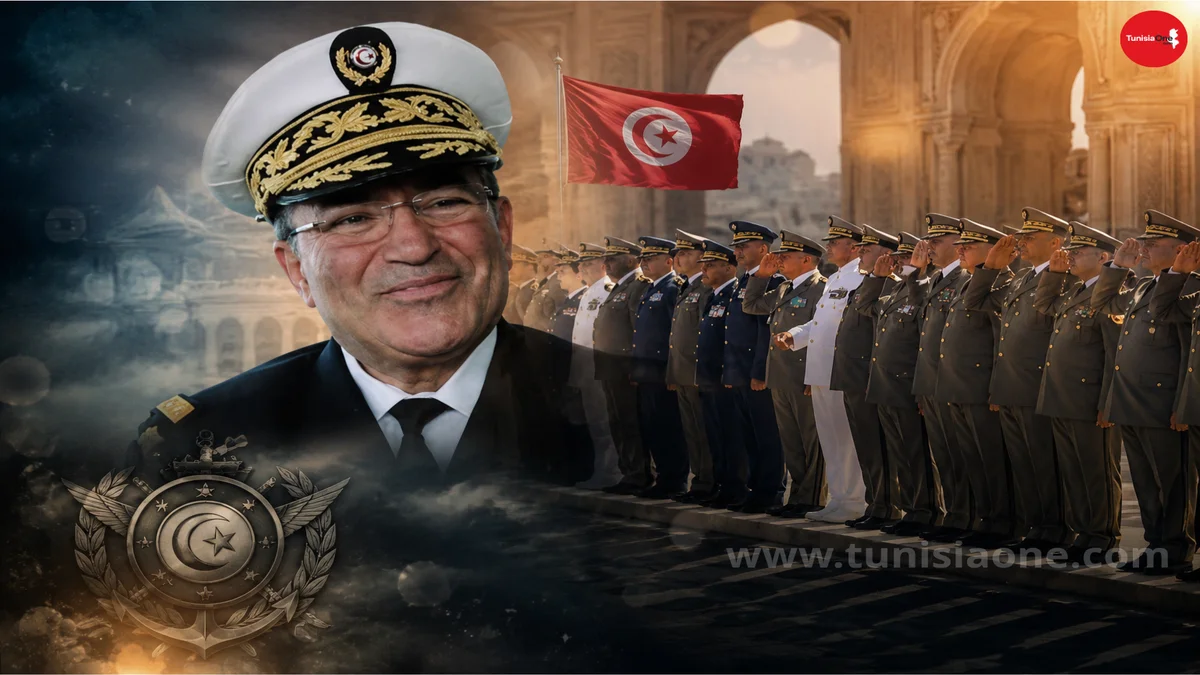
“The Tunisian Ministry of Defense Statement is currently sparking widespread reaction across the country. While it maintained an official, composed tone, observers see it as a strategic warning against the politicization of the military. Admiral (Ret.) Kamel Akrout offers an analytical reading of the “unseen” political dimensions within the text.”
Analysis of the Tunisian Ministry of Defense Statement
In a statement issued recently, the Tunisian Ministry of Defense affirmed the military’s unwavering commitment to political neutrality, emphasizing that its loyalty remains solely to the nation’s supreme interests and the Tunisian state, far from any partisan or personal agendas.
مقالات ذات صلة / Related Posts
Context: The Tensions That Sparked the Debate
This statement did not emerge in a vacuum; it followed a wave of political friction observed on social media since mid-May 2026.
Pressures to Involve the Military
The political landscape was stirred by a video from former President Moncef Marzouki, in which he explicitly called on the military and presidential security to intervene against the current leadership. This move, which many interpreted as a call to bypass constitutional order, prompted the military institution to break its usual reserve to firmly close the door on any attempts to drag the “Republican Army” into partisan conflicts.
Analysis of the Communiqué du Ministère de la Défense: Deciphering the Implicit
Admiral (Ret.) Kamel Akrout provided a thorough reading of the situation, describing it as a “deciphering of the invisible part of the text.” He noted on his official platform that the Ministry’s initiative to publish such a position serves as a necessary act of “strategic communication” during times of crisis.
The Rigor of Military Discourse
Akrout highlighted that the statement’s drafting was characterized by sobriety and calm. By avoiding inflammatory language, the Ministry focused exclusively on the institution’s pillars: patriotism, selflessness, and the primacy of national interest.
Independence and Neutrality: Pillars of Stability
The Admiral emphasized that the firm stance on “neutrality and independence” aims to firmly establish the doctrine of the Tunisian Army as a “Republican Army,” whose loyalty is exclusively to the state’s legal institutions.
The 3 Strategic Messages of the Statement:
- To the Political Sphere: Ending any attempt to involve the military in partisan calculations.
- To the Public: Reassuring society that the armed forces remain the ultimate guarantor of state stability.
- To the Military Ranks: Strengthening discipline and protecting the institution from external political influence.
The Republican Army: Loyalty to the Nation, Not Individuals
The statement serves as a vital reminder of the Tunisian Army’s identity: a “Republican Army” that adheres to the Constitution and legal institutions. This doctrine is exactly what makes the military the safeguard of the Tunisian state amidst political storms.
Stability and Institutional Trust
It is primordial to note that national stability rests on the people’s trust in their institutions. In these times of security challenges, the Tunisian Ministry of Defense Statement acts as a bulwark against misinformation. The clarity provided by Admiral Kamel Akrout allows citizens to better understand the strategic stakes and distinguish between voices that serve the national interest and those that seek to create chaos.
The Strategic Role of Institutional Communication
“Furthermore, the strategic communication adopted by the military institution serves as a cornerstone for maintaining national cohesion. By distancing itself from political polarization, the Tunisian Ministry of Defense Statement provides a sense of security to the public, ensuring that the armed forces remain a professional, state-serving entity. Admiral Kamel Akrout’s analysis highlights that in such critical times, maintaining the distinction between civil political life and military professionalism is not just a policy, but a constitutional necessity for the Republic’s future.”
Redrawing the Boundary Line
Faced with increasing polarization, the military institution aimed through this statement to redraw the clear boundary between military action and political agitation—a message that analysts interpret as a firm institutional reminder of the “Republican Army” doctrine.
This analysis is based on the official statement from the Tunisian Ministry of Defense and the public declarations of Admiral (Ret.) Kamel Akrout.
Why did Tunisian Ministry of Defense issue this statement?
To address recent political calls and attempts to involve the military in the ongoing political conflict.
What is Kamel Akrout’s analysis?
He interprets the statement as a “strategic communication” reaffirming military neutrality against political pressure.
What does “Republican Army” mean?
It refers to an army that strictly adheres to the Constitution and legal institutions, remaining independent of partisan politics.