


World Cup
Table of Contents
By: TunisiaONE Team | Updated: June 10, 2026
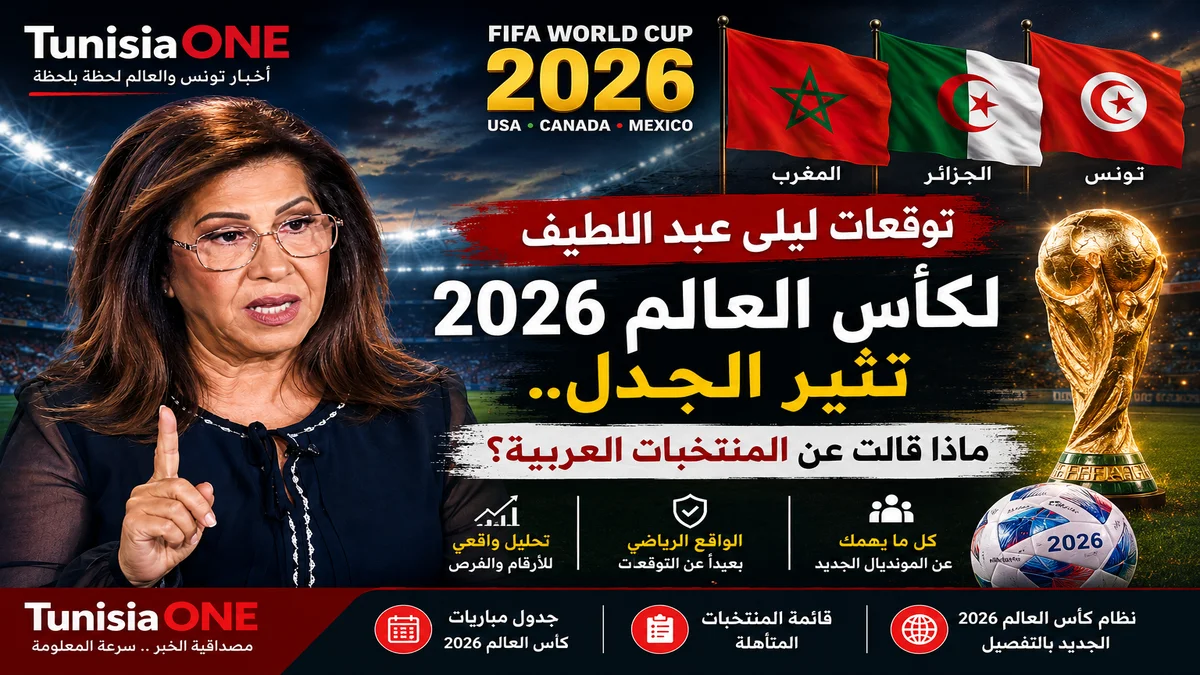
As the 2026 FIFA World Cup, hosted by the United States, Canada, and Mexico, approaches, the name “Leila Abdel Latif” has resurfaced at the center of public debate. Her recent statements, hinting at the possibility of Arab national teams achieving unexpected breakthroughs during the tournament, have gone viral across social media platforms.
مقالات ذات صلة / Related Posts
 إحالة محمد الغنوشي على الدائرة الجنائية في تونس.. 5 معلومات عن القضية
  Coupe du Monde 2026 : Le calendrier officiel et le guide complet du Mondial
  Justice : 8 ans de prison pour un cadre bancaire ayant détourné des milliers de dinars de comptes dormants
  Shocking Predictions: Leila Abdellatif Foresees Major Political Turmoil and the Release of Rached Ghannouchi in Tunisia
Despite the widespread interest, sports experts emphasize that evaluating the chances of national teams in the World Cup must be based on technical data, statistical analysis, and tactical preparation, rather than on unverified predictions.
Disclaimer: This article aims to cover the media buzz surrounding Leila Abdel Latif’s predictions and does not represent an endorsement or confirmation of any future events. Match results remain exclusively determined by performance on the pitch.
What exactly did Leila Abdel Latif say about the 2026 World Cup?
According to statements circulating on digital platforms, Leila Abdel Latif spoke of potential “major surprises” during the 2026 World Cup, suggesting that certain Arab teams could achieve results far exceeding public expectations. These statements do not rely on any sports data or statistical evidence, leading to a divide among fans: some view them as a source of morale-boosting optimism, while others prefer to rely on grounded sports analysis.
Why do these predictions attract so much attention?
Digital media experts suggest that the massive interest in predictions by high-profile media figures before major events stems from the audience’s curiosity for “what-if” scenarios. Social media platforms play a critical role in the viral nature of this content, especially when it concerns a global tournament followed by billions of people worldwide.
What do the numbers say about the Arab teams’ chances?
Beyond predictions, success in a World Cup depends on preparation, player quality, and team stability.
🇲🇦 Morocco
Morocco remains one of the most credible Arab contenders for a high-level performance, building on their historic 2022 World Cup run in Qatar, where they became the first Arab and African nation to reach the semi-finals.
🇩🇿 Algeria
The “Fennecs” possess a squad of internationally experienced players and aim for a strong return to the global stage through a sporting project that blends seasoned veterans with rising young talents.
🇹🇳 Tunisia
The “Eagles of Carthage” continue to rely on their tactical discipline and the experience gained from previous major tournaments, with a clear ambition to leave their mark on this new edition.
The Challenge for Arab Teams in the 2026 World Cup Groups
The draw for the 2026 World Cup presents varied challenges for the Arab representatives:
- Morocco (Group C): Drawn alongside Brazil, Scotland, and Haiti. A difficult group dominated by the Brazilian favorites, but the “Atlas Lions” have the experience necessary to compete for a qualification spot, particularly against Scotland and Haiti.
- Tunisia (Group F): Placed with the Netherlands, Japan, and Sweden. A balanced group where Tunisia has a realistic chance to compete for a qualifying spot. Their defensive style could pose serious tactical problems for the Netherlands and Sweden.
- Algeria (Group J): Opposed to Argentina (the defending champions), Austria, and Jordan. While the Argentine challenge is immense, the race for second place against Austria remains wide open. Mental fortitude will be Algeria’s primary ally.
The Impact of the New 48-Team Format
The expansion from 32 to 48 participants changes the tournament landscape:
- Increased number of slots for the African continent.
- Higher probability of seeing multiple Arab selections advance past the group stage.
- Greater opportunities for emerging nations to gain global tournament experience.
❓ Frequently Asked Questions (FAQ)
Did Leila Abdel Latif predict an Arab team would win the title?
No, there are no official statements confirming such a prediction. She spoke about “surprises” in general terms
Do FIFA rankings influence results on the pitch?
They influence the seeding during the draw, but they do not determine the outcome of the matches.
Does the new format favor Arab countries?
Mathematically, it offers more qualification chances, but actual success will depend on on-field performance.
Conclusion: Whether predictions come true or not, the 2026 World Cup remains an exceptional event. For Arab selections, success will ultimately be forged through hard work, technical discipline, and rigorous planning.
Do you think Morocco, Algeria, or Tunisia will create a surprise? Share your thoughts in the comments!
مقالات ذات صلة / Related Posts
إحالة محمد الغنوشي على الدائرة الجنائية في تونس.. 5 معلومات عن القضية Coupe du Monde 2026 : Le calendrier officiel et le guide complet du Mondial Justice : 8 ans de prison pour un cadre bancaire ayant détourné des milliers de dinars de comptes dormants Shocking Predictions: Leila Abdellatif Foresees Major Political Turmoil and the Release of Rached Ghannouchi in Tunisia